Wall Decals vs. Peel-and-Stick Wallpaper: Costs in 2026

Wall decals win on price when you want a few shapes on a wall, and lose badly when you want the whole wall covered. WallPops, a large decal brand, lists its decal sets at $10.99 to $45.99, with most around $21 for one 17.5 by 24 inch sheet. Peel-and-stick wallpaper for a 12 by 8 ft wall (96 sq ft) works out to roughly $104 to $240 in our estimate. Covering that same wall edge to edge with decal sheets would run near $690, and decals are not designed for that.
This guide compares decals, murals and peel-and-stick wallpaper on price, coverage, effort, wall rules, removal risk and reuse. Nearly every source we could read sells these products, so we flag where they disagree and which numbers are our own arithmetic.
What you are actually comparing
Brands mix these terms, so here is how we use them.
- Vinyl decals (wall stickers): die-cut shapes such as leaves, butterflies or letters on a backing sheet. You place each piece.
- Fabric decals: the same idea in a fabric-based material. Sellers pitch them as reusable and friendlier for nurseries.
- Murals: one large printed scene, sold as a few panels, either ready-made or cut to your wall size.
- Peel-and-stick wallpaper: rolls about 20.5 inches wide with a repeating pattern, hung in strips.
Only wallpaper is built to cover a wall with no gaps. If you have not yet decided between wallpaper and painting, start with our peel-and-stick wallpaper vs. paint guide.
What each option costs
Prices come from retailer and maker pages read in September 2026; most pages show no date, and prices move with sales.
- Decal sets: WallPops lists its collection at $10.99 to $45.99. One example set is 14 butterflies on a single 17.5 by 24 inch sheet for $20.99. A 2026 nursery guide from Decords shows best sellers from about $8.88 to $44.97.
- Fabric decals: listings on one seller’s page ran $77 to $291. That is one company, so do not read it as a market average.
- Ready-made murals: WallPops lists $59.99 to $199.99. The one listing that gives dimensions is a seven-panel mural, 6 ft high by 10.5 ft wide (63 sq ft), at $188.99, which is $3.00 per sq ft by our math.
- Custom-printed murals: Tempaper charges $12 per sq ft with a 4 sq ft minimum. A mural-seller guide gives $1.40–$2.00 per sq ft for budget vinyl, $5.00–$6.90 for non-woven and $7.43–$11 or more for fabric.
- Peel-and-stick wallpaper: WallPops lists rolls from $25.99 to $59.99, most at $49.99. Its $25.99 Breezy roll is 20.5 in by 18 ft, about 30.8 sq ft, so roughly $0.84 per sq ft. Tempaper’s double rolls (56 sq ft each) run $12.99 to $150.
Same 12 x 8 ft wall (96 sq ft), by approach
- Decal sets, scattered accent (1 to 3 sets)$21–$63
At WallPops $20.99 per set. Covers a fraction of the wall.
- Fabric decal sets (seller listings)$77–$291
One seller only; sizes vary.
- Ready-made mural (WallPops listing)$60–$200
The one size we could confirm, 63 sq ft, is about two-thirds of this wall.
- Peel-and-stick wallpaper, 4 rolls$104–$240
Our estimate: 4 rolls of about 30.8 sq ft at $25.99 to $59.99. Assumes the $49.99 and $59.99 rolls are similar in size.
- Custom-printed mural, 96 sq ft$134–$1,152
$1.40 per sq ft (budget vinyl) up to Tempaper at $12 per sq ft. Our arithmetic.
The mural range is wide because materials differ: the mural guide says moving from basic vinyl to non-woven adds about 40 percent, and premium fabric another 40 to 60 percent. That guide also lists whole-mural tiers of $20–$80, $80–$200 and $200–$500 or more without saying what wall size they assume, so we used its per-square-foot figures.
The Walls Need Love renter guide gives $15–$150 for vinyl decals and murals and $1–$4 per sq ft for peel-and-stick wallpaper. For our wall that is $96 to $384, wider than our roll-based estimate, and the page does not explain the gap.
Coverage and seams
The wall size matters more than the price per piece.
A decal sheet is mostly empty backing. The 17.5 by 24 inch sheet is about 2.9 sq ft, and 96 divided by 2.9 is about 33 sheets, or roughly $693 at $20.99. That is a floor, because cut shapes never fill a sheet, and it is our arithmetic, not a plan. Decals have no seams to line up, but they leave gaps by design.
Wallpaper has the opposite issue. A 12 ft wall needs 8 strips of 20.5 inch material, and a large pattern repeat can double the roll count. The Breezy roll lists a 20.8 inch repeat. Our peel-and-stick wallpaper guide has a worked example, and our removable wallpaper cost per room guide covers whole rooms.
Murals sit in the middle: a few large panels and few seams, but the design has to suit your wall’s dimensions.

Install time and effort
Decals are the easier job. One renter blog says they go up in minutes, and the same blog calls peel-and-stick wallpaper a tricky DIY project for beginners. The Decords nursery guide suggests marking the decal’s outline on the wall with removable tape first, placing the largest piece first, then adding the smaller ones. Fathead, which sells large decals, tells buyers to start removal with two people, so expect large pieces to be a two-person job.
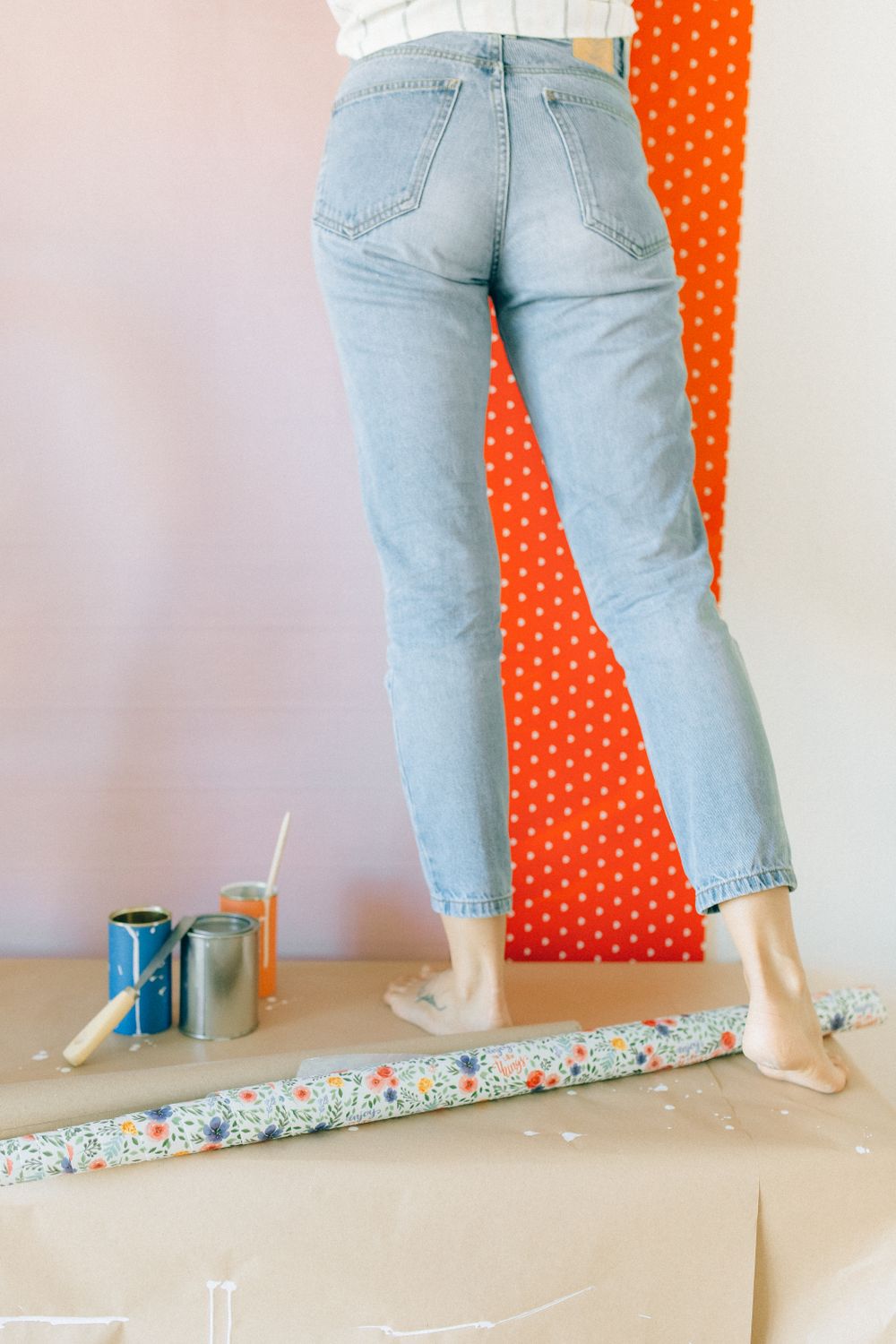
Wallpaper takes more steps: measuring, cutting, leveling and smoothing each strip. Our peel-and-stick guide collects seller time claims, from under 2 hours for an accent wall to an afternoon for a room.
Which walls work, and where sources disagree
Everyone agrees on the ideal: smooth, clean, dry, painted walls. The details differ.
| Point | What sources say |
|---|---|
| Wait after painting | Blik: 2 to 3 weeks. A decal seller (Custom Vinyl Decor): 2 to 3 weeks. Fathead: 30 days. Tempaper’s mural page: at least 4 weeks. |
| Light texture (orange peel) | Blik says even mild texture can prevent adhesion. Fathead says texture shortens how long a decal stays up. Tempaper does not recommend texture but allows a sample test. |
| Heavy texture | Custom Vinyl Decor says avoid knockdown and popcorn finishes. One mural guide prices a skim coat at $100 to $500. |
| Flat or matte paint | Custom Vinyl Decor says it is more porous and may show faint outlines after removal from uneven fading, not damage. |
| Bathrooms | Blik says decals work in well-ventilated ones; it does not recommend its pattern wall tiles there. |
The cure-time spread is real: 2 weeks to over 4. None of the pages we read says a longer wait causes a problem, so if in doubt, use the longest figure.
One blogger who has removed peel-and-stick wallpaper reports the opposite pattern to the manufacturers on texture: slightly textured walls gave cleaner removals because the paper had not bonded fully, and smooth walls lost more paint. It is one person’s experience. A likely reading (ours) is that weaker adhesion helps removal and hurts staying power, which fits Fathead’s warning that texture shortens stick time. Do not choose a textured wall on purpose.
Damage and removal risk
The sellers say their products come off without residue. WallPops describes its decals that way. Blik says its decals should leave no goo, but also that it cannot guarantee the condition of every wall, and that paint chips can turn up on the decal backs. Fathead warns that pulling a decal straight off can stretch it, tear it or lift paint. One renter blogger reports finding a patch of paint 3 to 4 inches across stuck to the back of removed wallpaper, and says wallpaper left up longer (3 years versus 1 to 2) pulled more paint.
We found no source comparing decals and wallpaper head to head for paint damage. Our inference is that a small decal bonds less area than a wallpapered wall, so a bad result would be a smaller patch. A mural or large decal has a wallpaper-sized footprint.
Removal steps agree: peel slowly, folding the piece back on itself, with a hair dryer for stubborn spots. The heat setting differs. One real-estate publisher says to hold a dryer on high 1 to 2 inches from the surface, while a decal seller says low. Start low.
If damage remains, Redfin’s repair is to sand rough edges, fill divots with drywall paste, sand smooth, then prime and paint, and it warns that painting over uncleaned residue looks blotchy. One mural seller cites about $609 for drywall repair; treat that as that company’s figure.
Durability and reuse
Lifespan claims do not agree. Blik says indoor decals last 1 to 2 years with proper care. A decal seller says quality vinyl can stay up 5 to 7 years or more without issues. A mural seller gives 1 to 5 years, and the Walls Need Love guide says peel-and-stick wallpaper lasts about 3 to 5 years in ideal conditions. We would plan on a few years for any of them.
Reuse is where decals differ most:
- WallPops calls its decals removable, reusable and repositionable.
- Blik says its standard decals are one-time use, and only its Re-Stik line can be moved.
- Fathead says you can reapply a decal, but it recommends putting it back on the original backing (or a vinyl shower curtain liner) and warns the adhesive may weaken, in which case a low-tack craft spray helps.
- Wallpaper: one seller says it can be applied and removed 2 to 3 times. Tempaper’s double-roll page does not say it is repositionable. Strips cut to fit one wall are unlikely to fit another (our inference).
If you may move in a year or two, only a decal set with a reuse claim, kept on its backing, is likely to come with you.
When to choose which
| Your situation | Better fit |
|---|---|
| Small motif, shelf corner, or a few shapes | Decals |
| Nursery or kids room you will redo | Decals; fabric if the seller supports reuse |
| One full accent wall with a pattern | Peel-and-stick wallpaper |
| One scene across a whole wall | Mural |
| Lightly textured walls | Neither; test a sample first |
| Lease under about a year | Decals |
| Bathroom or steamy kitchen | Decals in a ventilated room; see bathroom painting costs for paint |
| Full room on a small budget | Neither; paint is cheaper |
The table is our own reading of the sources, not a rule any of them states.
For a nursery, sellers pitch decals as easy to change as a child grows: Decords advises designs that suit the move to a toddler room, and Max & Lily says its fabric decals can be restuck. Both are sellers, and neither gives a reuse count.
Renting: permission and deposit
Neither product removes the need to ask. A property-management guide says most leases bar permanent changes without written approval and suggests photographing the rental before you decorate. It lists removable decals and peel-and-stick wallpaper as damage-free options; that is its claim, not a test. Get permission in writing and keep the photos. Our deposit guide explains what landlords deduct, and renter-friendly upgrades with prices has other low-risk ideas.
Common mistakes
- Applying to fresh paint. Follow the longest wait you find, up to 4 weeks.
- Washing the wall with soap. Fathead says soap or cleaners can hurt adhesion; use a damp cloth. Tempaper recommends a 1:1 alcohol and water wipe. Check your product’s instructions.
- Filling a wall with decals. The sheet price hides how much empty backing you buy.
- Skipping the layout. Mark the spot with removable tape before peeling.
- Waiting to apply. Blik says to apply decals within a month of receiving them.
FAQ: wall decals vs. peel-and-stick wallpaper
Are wall decals cheaper than peel-and-stick wallpaper?
For a small accent, yes: a WallPops set is around $21. For a full 96 sq ft wall, no: wallpaper rolls come to roughly $104 to $240 in our estimate, against near $690 in decal sheets.
Are wall stickers better than wallpaper for renters?
Neither is clearly safer. Sellers say both remove cleanly from smooth, cured paint, and the wall finish matters more than the product. Decals cost less to try and bond a smaller area (our inference); wallpaper gives a finished look. Get written permission either way.
Do wall decals damage paint?
On smooth, cured paint, sellers say no. Blik still says it cannot guarantee any wall, and Fathead warns that pulling decals straight off can lift paint. Fresh paint, texture and flat finishes raise the odds. Test a small piece first.
Can I reuse wall decals?
Some, not all. WallPops says its decals are reusable, but Blik says its standard ones are single use and only Re-Stik can be moved. Fathead says you can reapply if you store the decal on its backing, though the adhesive may weaken over time.
Can I use decals on textured walls?
Usually not. Blik says even mild orange peel can stop adhesion, and Fathead says texture shortens how long a decal stays up. If your wall is lightly textured, test one decal for several days before buying more.
How long after painting can I apply decals?
Sources say 2 to 3 weeks (Blik, Custom Vinyl Decor), 30 days (Fathead) or 4 weeks (Tempaper’s mural page). Wait the longest figure if you can, because applying too early can pull soft paint off.
Sources
Figures were checked in September 2026. Most are from companies that sell these products, which we note in the text. Prices change with sales and region, so treat them as planning ranges.
- WallPops: wall decals: decal price range, reusable and repositionable claims.
- WallPops: Spread Your Wings decals: 14-piece set, 17.5 by 24 inch sheet, $20.99.
- WallPops: peel and stick wallpaper: roll price range.
- WallPops: Breezy wallpaper: roll size, coverage, repeat, price.
- WallPops: peel and stick wall murals: mural prices and a 63 sq ft example.
- Blik FAQs: surfaces, texture, paint cure, reuse, lifespan, damage disclaimer.
- Fathead: reusing items: removal, storage and reapplication.
- Fathead: recommended surfaces: surfaces, 30-day paint wait, texture.
- Custom Vinyl Decor: do wall decals damage walls?: paint cure, flat paint, removal, lifespan.
- Redfin: how to remove wall decals: removal methods and repair steps.
- Walls Need Love: renter-friendly wall covering options: price ranges, test patch.
- Peel and Stick Wall Murals: 2026 cost guide: per-sq-ft mural prices, lifespan, repair figure.
- Tempaper: custom wall mural: $12 per sq ft, surface and cure guidance.
- Tempaper: double roll wallpaper: price range, 56 sq ft rolls.
- Decords: nursery decals guide: price range and layout advice.
- Max & Lily: reusable decals for kids’ rooms: fabric decal claims and listing prices.
- The Homes I Have Made: 12+ temporary ways to update rental walls: renter view of decals and wallpaper.
- The Homes I Have Made: does peel-and-stick wallpaper damage walls?: one person’s removal experience.
- Limitless Walls: does removable wallpaper damage paint?: reuse claim.
- Property Management Platinum: decorating a rental: lease, permission and photo advice.