Removable Wallpaper Cost Per Room in 2026: Rolls and Prices
Removable wallpaper is sold in small rolls, and that is what drives the bill. A common single roll is 20.5 inches wide and 16.5 feet long, about 28 square feet, so a 12-foot accent wall takes 4 rolls when the pattern needs no matching and 8 when it has a 12-inch repeat. At mainstream prices of roughly $25–$45 a roll, that is $100–$180 or $200–$360. A 12×12 ft bedroom comes to about $375–$675 in the best case and $725–$1,305 once the pattern has to line up.
Prices below come from manufacturer and retailer pages and two cost guides, read in September 2026 (one guide is dated January 2025). Room totals are our own arithmetic from roll size and price, not quotes. A calculator further down lets you rerun the math with your own wall.
What one roll actually covers
Every price in this article depends on roll size, and the sizes are not consistent. Here is what the pages we read say.
| Format | Size | Coverage | Source |
|---|---|---|---|
| Single roll | 20.5 in × 16.5 ft | 28 sq ft | Tempaper FAQ |
| Single roll | 20.5 in × 18 ft | 30.75 sq ft | WallPops |
| Double roll | 20.5 in × 11 yd (33 ft) | 56 sq ft | Tempaper FAQ |
| Double roll | 27 in × 11 yd | 60 sq ft | Tempaper FAQ |
| Peel-and-stick “double roll” | 27 in × 18 ft | about 40.5 sq ft (our arithmetic) | Hygge & West ordering page |
| Panels | 2×4, 2×8 or 2×12 ft | 8, 16 or 24 sq ft (our arithmetic) | Chasing Paper FAQ |
| Sheets | 24 in wide, up to 144 in tall | sold by height | Rocky Mountain Decals |
A “double roll” is 56 sq ft at Tempaper and about 40.5 at Hygge & West, so convert everything to square feet before comparing prices. Label coverage is also not usable coverage: the Wallpapers To Go calculator assumes rolls are 85–95% usable.
Price per roll and per square foot, by tier
| Tier | Listed price | Roll size | Per sq ft (our arithmetic) |
|---|---|---|---|
| Mainstream single rolls | $20–$45 (Fixr, Jan 2025); from about $25 (Taskrabbit, Sept 2026); $25.99–$59.99 (WallPops shop, Sept 2026) | 28–30.75 sq ft | about $0.80–$1.60 for $25–$45 |
| Designer double rolls (Tempaper) | $60–$150; clearance from $12.99 | 56 sq ft | about $1.07–$2.68; clearance about $0.23 |
| Boutique designer (Hygge & West) | from $125; newer designs $245–$275 | see note | about $3.10–$6.80 |
| Custom-cut (Giffywalls, 2026) | $4.99 per sq ft | cut to your wall | $4.99 |
Note on Hygge & West: its collection page does not say whether the prices are per single or double roll. Its ordering page lists peel-and-stick as a 27 in × 18 ft double roll, and our per-foot figure assumes the prices are for that roll.
The sources do not explain the spread between $0.80 and $6.80 per square foot beyond brand and design. One undated blog we read says Amazon prices swing from day to day and Target endcap rolls are sometimes $6–$12, so treat list prices as a starting point.
Materials for a 12 ft × 8 ft accent wall (96 sq ft)
- Mainstream single rolls, no repeat$100–$180
4 rolls at $25–$45. Our arithmetic.
- Mainstream single rolls, 12-inch repeat$200–$360
8 rolls at $25–$45. Our arithmetic.
- Tempaper double rolls, no repeat$120–$300
2 double rolls at $60–$150. Our arithmetic.
- Tempaper double rolls, 12-inch repeat$180–$450
3 double rolls at $60–$150. Our arithmetic.
- Custom-cut at $4.99 per sq ft$479
96 sq ft, cut to size. Our arithmetic.
Cost to cover typical rooms
Method: we divided the wall run (the perimeter) by 20.5 inches and rounded up to get strips, gave each strip the wall height plus 2 inches of trim allowance, and fitted strips onto a 198-inch single roll. Ceilings are 8 ft, prices are $25–$45 a roll, and doors and windows are not subtracted. Real rooms have offcuts you can sometimes reuse, so treat these as upper-end planning numbers.
| Room | Assumed size | Rolls, no repeat | Cost | Rolls, 12-inch repeat | Cost |
|---|---|---|---|---|---|
| Accent wall | 12 ft wide | 4 | $100–$180 | 8 | $200–$360 |
| Powder room | 6×8 ft | 9 | $225–$405 | 17 | $425–$765 |
| Small bedroom | 10×10 ft | 12 | $300–$540 | 24 | $600–$1,080 |
| Full bedroom | 12×12 ft | 15 | $375–$675 | 29 | $725–$1,305 |
| Living room | 14×18 ft | 19 | $475–$855 | 38 | $950–$1,710 |
Published room totals run higher. Fixr (January 2025) gives $800–$1,200 for a 12×18 ft bedroom and $650–$1,200 for a bathroom of about 170 sq ft, but those include installation and cover wallpaper in general, not peel-and-stick alone. Giffywalls (2026) lists about $819 in materials for a 210 sq ft bedroom in its standard paper, or about $1,048 at its $4.99 peel-and-stick price (our math).
For a paint comparison on the same rooms, see our guides to painting a bedroom and a bathroom, and the head-to-head in peel-and-stick wallpaper vs. paint.
How pattern repeat and match type change the count
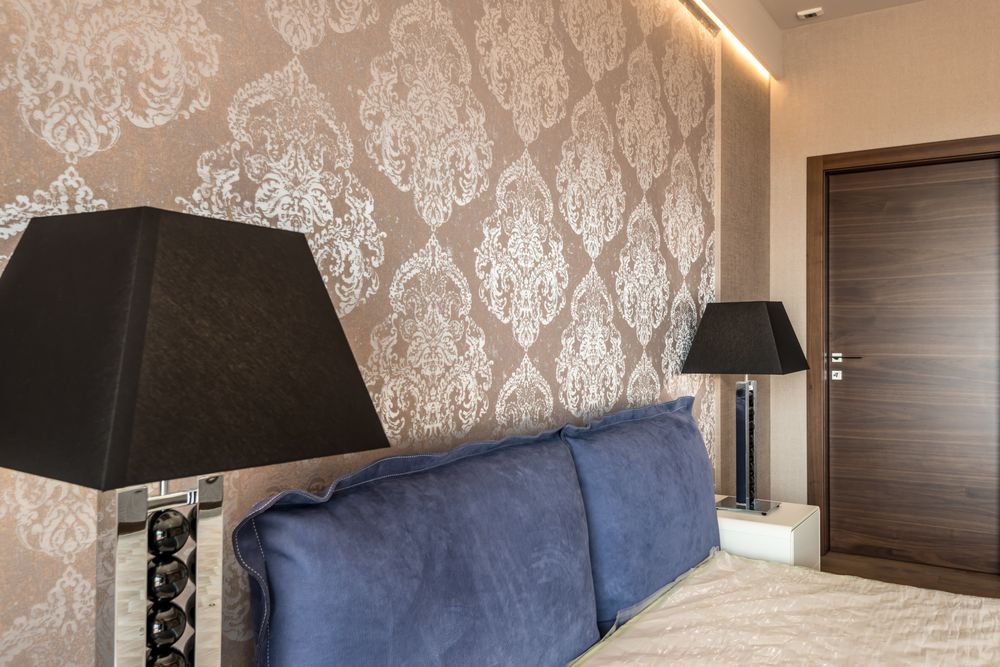
The vertical distance before a pattern repeats is called the repeat. WallPops says repeats commonly run from 0 to 27 inches, and that repeats over 21 inches need extra material. Match type matters too:
- Random match: no alignment needed at the seams. WallPops describes it as the easiest and says it generates no waste from matching. Textures and small all-over prints often work this way.
- Straight match: the pattern lines up horizontally across strips, so every strip starts at the same point in the design.
- Drop match: the pattern lines up diagonally, so alternate strips start at a different point.
Sellers give different overage advice, and all of them sell rolls, so read these as cautious ranges:
| Seller | Guidance |
|---|---|
| Chasing Paper | Pad the order by 15%. |
| Hygge & West | If in doubt, order an extra roll, since prints can differ slightly between lots. |
| WallPops | Consider an extra roll depending on repeat size and ceiling height. |
| Wallpapers To Go | Patterned designs may need 25–70% more than plain area math. |
| Giffywalls | Roll-based orders need about 20% extra for pattern matching. |
Percentages hide why the effect is so lumpy on 8-foot walls. A 16.5 ft roll is 198 inches. Two strips of 98 inches (96 inches of wall plus 2 inches of trim) fit in it, with 2 inches to spare. If the repeat forces even one strip up to 100 inches, only one strip fits per roll and the roll count doubles. That is our arithmetic, and it is why the 12-inch repeat above doubles the accent wall from 4 rolls to 8.
Ceiling height, openings and double rolls
Height matters more than most cost guides admit. Rocky Mountain Decals’ sheets top out at 144 inches and it asks you to contact the company for taller walls. Tempaper recommends its 56 sq ft double rolls for walls over 8 feet. Our arithmetic shows why: past about 8 ft 1 in, a 198-inch single roll yields one strip, so a 9 ft ceiling costs as much as a 12-inch repeat on an 8 ft one.
Here is a 12 ft wide wall (8 strips) under different roll and height conditions, with a 33 ft double roll being 396 inches long:
| Setup | Strip length | Strips per roll | Rolls | Materials |
|---|---|---|---|---|
| Single, 8 ft, no repeat | 98 in | 2 | 4 | $100–$180 at $25–$45 |
| Single, 8 ft, 12-in repeat | 108 in | 1 | 8 | $200–$360 |
| Single, 9 ft, no repeat | 110 in | 1 | 8 | $200–$360 |
| Double, 8 ft, no repeat | 98 in | 4 | 2 | $120–$300 at $60–$150 |
| Double, 8 ft, 12-in repeat | 108 in | 3 | 3 | $180–$450 |
| Double, 9 ft, no repeat | 110 in | 3 | 3 | $180–$450 |
Double rolls win on roll count, not price: a $150 double roll is $2.68 a square foot against roughly $0.80–$1.60 for a mainstream single. Choose doubles when the wall is taller than 8 feet or the repeat is large, and only if the per-foot price is close.
Doors and windows are simpler. Wallpapers To Go does not subtract them because trimming around openings uses about as much paper as covering them, Rocky Mountain Decals says to ignore them, and Hygge & West says they matter only when they take up a big part of the wall.
Use the calculator: a worked example
Wallpaper roll calculator
Works out how many peel-and-stick or standard rolls you need, including the waste a pattern repeat causes.
Method: number of strips = wall width divided by roll width, rounded up. Each strip is the wall height plus 2 inches of trim allowance, rounded up to the next pattern repeat. Rolls = strips divided by how many strips fit in one roll, rounded up. Doors and windows are not subtracted, because strips over them are still cut full length. Check your product's own instructions and buy every roll from the same batch. This is a planning estimate.
Enter the total width of the walls you will cover (the perimeter for a whole room, such as 48 ft for 12×12), the wall height, the roll size and price from the product page, and the pattern repeat in inches. The result shows strips, strips per roll, rolls to buy and cost, next to what plain area math would say.
The default is a 12 ft × 8 ft wall with a $30 roll of 20.5 in × 16.5 ft:
- No repeat: 8 strips, each 98 inches, 2 strips per roll, so 4 rolls and $120. Area math also says 4.
- Change the repeat to 12: strips become 108 inches, 1 fits per roll, so 8 rolls and $240. Area math still says 4, which is the mistake the calculator is built to catch.
- Switch to a double roll: set the roll length to 33 and the price to $90, keeping the 12-inch repeat. Three strips fit per roll, so 3 rolls and $270. That is close to the $240 for 8 singles, but you buy 168 sq ft instead of 224.
The calculator rounds every strip up to a full repeat, so it is a planning estimate, not a cutting plan. If the result lands right at a roll boundary, buy the extra roll.
What a professional install adds
Most removable wallpaper is designed for DIY, so labor is optional. If you hire someone, Taskrabbit’s guide (updated September 1, 2026) lists $56–$85 an hour, $62 on average, $2–$6 per square foot, and minimum fees of $150–$300, with 2–4 hours for an accent wall, 4–8 for a bathroom and 6–12 for a bedroom. Fixr’s per-roll method is $30–$70. Giffywalls puts labor at $2–$7 per square foot.
Our arithmetic at the $62 average: about $124–$248 in labor for an accent wall and $372–$744 for a bedroom, on top of materials. None of the pages we read gave a lower rate for peel-and-stick. Our peel-and-stick vs. paint guide covers when hiring pays off.
Samples, returns and what happens to leftover rolls
Check the policy before you order, because it varies more than the price:
- Tempaper: offers samples (final sale). Unused rolls in original packaging can go back within 30 days of delivery at your shipping cost; custom prints and products sold by square foot or panel are excluded unless defective.
- Hygge & West: takes back unopened rolls within 30 days of delivery, and its collection page offers samples.
- Chasing Paper: sells 9.6 × 8 inch samples (final sale). Products are made to order, so all sales are final, with 48 hours to report a manufacturing defect.
Standard rolls can often go back if unopened; cut-to-order panels and custom prints cannot, so count carefully with those.
Renting? What this means for your deposit
The wall decides how cleanly it comes off. Chasing Paper asks for smooth eggshell, satin or semi-gloss paint that has cured 4–6 weeks; Tempaper says at least 30 days. Get permission in writing and see our checklist on getting your full security deposit back. Cheaper reversible options are in renter-friendly upgrades with prices and removable wallpaper vs. wall decals.
Ways to spend less
- Choose a random-match or small-repeat print. It is the biggest lever on roll count.
- Paper one wall. It cuts the total to a fraction of a full room.
- Order a sample first. A print that looks wrong after delivery costs far more than a sample.
- Watch for sales. Chasing Paper advertised 20% off sitewide when we looked, and Tempaper listed clearance from $12.99 a double roll. Buy every roll at once, because prints can vary between lots, and clearance patterns may not be reorderable (our inference).
- Skip custom-cut unless the wall is odd. At $4.99 per square foot it costs more than most rolls, though it avoids roll waste on small or awkward walls.
- Hang it yourself. That saves the $2–$6 per square foot labor.
Removable wallpaper cost FAQ
How many rolls of peel-and-stick wallpaper do I need for a bedroom?
For a 12×12 ft room with 8 ft ceilings and 28 sq ft single rolls, our arithmetic gives about 15 rolls if the pattern needs no matching and about 29 with a 12-inch repeat. Area math alone says 14. Add the extra roll sellers suggest for lot differences.
How much does it cost to wallpaper one accent wall?
A 12×8 ft wall is about $100–$180 in mainstream rolls when there is no repeat to match, and $200–$360 with a 12-inch repeat. Designer double rolls raise that to $120–$450, and custom-cut is about $479 at $4.99 per square foot. Labor is extra.
Should I subtract doors and windows?
Usually not. Wallpapers To Go says trimming around openings takes about as much material as covering them, and Rocky Mountain Decals tells you to ignore them. Hygge & West says openings rarely matter unless they take up a big part of the wall.
Can I return leftover rolls?
Sometimes. Tempaper and Hygge & West take back unused or unopened rolls within 30 days of delivery, and Tempaper charges you for return shipping. Chasing Paper’s made-to-order products are final sale, and samples at Tempaper and Chasing Paper cannot be returned.
Sources
Figures were checked in September 2026 and can change with sales. Most of these pages belong to companies that sell wallpaper, so the overage advice leans toward buying more.
- Tempaper: FAQ: single and double roll sizes, match types, samples, 30-day cure time.
- Tempaper: double roll collection: 56 sq ft rolls, price range, advice for tall walls.
- Tempaper: shipping and returns: 30-day returns and exclusions.
- Hygge & West: ordering wallpaper: roll sizes, extra-roll advice, lots, returns.
- Hygge & West: peel and stick collection: prices and sample availability.
- Wallpapers To Go: wallpaper calculator: roll sizes, usable coverage, pattern overage, openings.
- WallPops: understanding pattern repeats: match types, repeats, 20.5 in roll sizes.
- WallPops: peel and stick collection: price range.
- Rocky Mountain Decals: wallpaper calculator: sheet width, maximum height, openings.
- Chasing Paper: FAQ: 15% overage, panel sizes, samples, final-sale policy.
- Chasing Paper: wallpaper collection: sale banner.
- Taskrabbit: wallpaper installation cost: hourly and per-foot labor, hours by room (updated September 2026).
- Fixr: wallpaper installation cost: per-roll prices, labor, room totals (January 2025).
- Giffywalls: wallpaper cost per square foot: custom-cut prices, labor, roll overage.
- The Homes I Have Made: where to buy peel-and-stick wallpaper: retailer price observations (undated blog).