Cost to Paint Kitchen Cabinets in 2026: DIY vs. Pro
Painting kitchen cabinets yourself usually costs $200–$600 in materials. Hiring a painter most often costs $2,000–$6,500, although the published range stretches from about $900 to $12,000 depending on kitchen size, door style and which guide you read. The difference is almost entirely labor: cleaning, sanding, priming and two coats of paint on both sides of every door.
This guide compares eleven cost guides from 2023 to 2026 with manufacturer data sheets for drying and curing, and shows where they disagree. It includes a worked DIY example (our own arithmetic) and an honest time estimate. For painting versus refacing or replacing, see our cabinet refacing vs. repainting vs. replacing comparison; this article stays on painting.
What professionals charge
Painters price this job per door, per linear foot of cabinets, or as a whole-kitchen quote. The guides below do not agree.
| Source (date) | Per door | Per drawer front | Per linear foot | Whole kitchen |
|---|---|---|---|---|
| Kitchensearch (2026) | $90–$175 | $30–$50 | $30–$60 | $2,000–$6,500 |
| All Bright Painting (Jan 2026) | $70–$125 | not listed | not listed | $2,000–$6,500 average |
| Ranger Painting (Aug 2026) | $100–$185 (Austin) | not listed | $40–$100 sprayed | $3,000–$9,000 |
| RealCostIQ (Sept 2026) | $100–$250 | $50–$100 | $30–$70 | $900–$3,800 |
| Bob Vila (Sept 2023) | about $100 | about $25 | not listed | $422–$1,415, average $895 |
Per square foot of cabinet surface, Kitchensearch and Bob Vila both give $3–$10, and Homewyse’s calculator (May 2026) shows $5.40–$10.79. One further guide lists as little as $25–$75 per door, which looks like an outlier next to the rest.
The sources do not explain why a whole kitchen runs from $900 to $12,000. Our inference: they mean different kitchens, since a 15-piece galley and a 50-piece kitchen with an island are different jobs, and quotes may or may not include boxes, hardware or a topcoat. Bob Vila’s 2023 figures sit far below every 2026 page, so we would not plan around them.
How big is a “small” or “large” kitchen?
Sizing is where guides quietly differ. Three 2026 pages that price by kitchen size count doors and drawer fronts, the pieces a painter must finish:
| Kitchen | Ranger (Aug 2026) | Family Interiors (Jul 2026) | Kitchensearch (2026) |
|---|---|---|---|
| Small | 12–20 pieces, $3,000–$4,500 | 10–20 cabinets, $1,000–$4,000 | 15–25 pieces, $2,000–$3,500 |
| Medium | 20–35 pieces, $4,500–$7,000 | 20–35 cabinets, $4,000–$7,000 | 30–45 pieces, $3,500–$6,500 |
| Large | 35+ pieces, $7,000–$9,000+ | 35–50+ cabinets, $7,000–$12,000 | 50–70+ pieces, $6,500–$10,000+ |
Count every door and drawer front in your own kitchen before you get quotes or buy paint. That number matters more than any average.
Painting kitchen cabinets: DIY vs. professional by kitchen size
- DIY materials (any size)$200–$600
Typical range across several 2026 guides; a few go up to $800.
- Professional, small kitchen$1,000–$4,500
Roughly 10–25 doors and drawer fronts.
- Professional, medium kitchen$3,500–$7,000
Roughly 20–45 pieces, depending on the guide.
- Professional, large kitchen$6,500–$12,000
Roughly 35–70 pieces or an island.
What a DIY job costs
Guides put DIY materials at $200–$600 for a small to medium kitchen, and some reach $800. Here is what makes up that number.
| Item | Typical cost |
|---|---|
| Degreaser or cleaner | $15–$50 |
| Sandpaper or sanding sponges | $15–$40 |
| Bonding primer, per gallon | $30–$70 |
| Cabinet enamel, per gallon | $40–$120 (water-based latex $30–$70, oil-based $40–$90, specialty cabinet paint $60–$120) |
| Brushes and mini rollers | $10–$20 |
| Painter’s tape and drop cloths | $10–$25 |
| Sprayer rental, optional | $40–$100 per day (buying one runs $40–$300) |
| New knobs or pulls | $3–$15 each |
A worked example (our arithmetic)
Take a kitchen with 20 doors and 8 drawer fronts, painted with a brush and mini roller, existing hardware reused. We assume 1 gallon of primer and 2 gallons of enamel, which is generous: Benjamin Moore’s data sheet for Advance lists 400–500 sq ft per gallon per coat, so you may have paint left over.
- Materials at the low end of each line: $15 + $15 + $30 + $80 + $10 + $10 = $160.
- Materials at the high end: $50 + $40 + $70 + $240 + $20 + $25 = $445.
- A pro using Kitchensearch’s per-piece prices: 20 doors at $90–$175 plus 8 drawer fronts at $30–$50 = $2,040–$3,900.
That is a saving of roughly $1,600–$3,700. If the job takes 30–45 hours, it works out to about $35–$125 per hour of your time. Treat it as a comparison, not a quote.
Choosing the paint
Cabinets face grease, hands and scrubbing, so the usual advice is a dedicated cabinet enamel over a bonding primer, not wall paint. Family Handyman’s roundup groups the options like this:
| Type | What to know |
|---|---|
| Waterborne alkyd (hybrid) | Benjamin Moore Advance is the example the roundup gives. Its data sheet describes a waterborne alkyd enamel with good flow and leveling, soap-and-water cleanup, and a slight yellowing risk that is more visible in lighter colors. |
| Water-based cabinet enamel | Cleans up with water. Insl-X Cabinet Coat and Rust-Oleum Painter’s Touch are the roundup’s examples, and Behr sells one too. |
| Oil-based enamel | Cures harder than latex, but slowly: one product in the roundup takes 21–30 days. |
| Chalk paint | Gives an aged, matte look but needs a hard topcoat to survive a kitchen, so the topcoat does the real work. |
Sheen matters too: glossier finishes show every flaw, and Family Handyman suggests satin or eggshell. A pro-applied protective topcoat is listed as an add-on at $100–$400.
Why prep decides how long it lasts
Every guide we read says the paint is the easy part. A durable job follows this order.
- Remove doors, drawer fronts and hardware, and label each piece. Family Handyman says you will not get a professional result if you skip this.
- Degrease with a grease-cutting cleaner, not just dish soap, then rinse and dry.
- Fill and sand. Fill dents and holes. Family Handyman suggests a 120-grit scuff on previously painted cabinets, while Benjamin Moore’s data sheet asks for 220-grit or coarser before priming.
- Prime. Sherwin-Williams says to test its bonding primer on a hidden spot, let it dry at least 24 hours, then sand lightly with very fine paper.
- Paint two coats, using a small brush for details and a mini roller for flat areas.
A Colorado painting company puts well-prepped cabinets at 10 years or more and skipped prep at 1–2 years. Another contractor blog says 3–7 years for DIY against 8–10 for a professional job. These are company estimates, not independent studies, but they match what the data sheets demand.
How long it takes
Bob Vila’s 2023 guide estimates about 20 hours of prep and removal plus 15–30 hours of priming, painting and reinstalling for roughly 200 sq ft of cabinets, so 35–50 hours. Family Handyman’s spray project says to plan on four to five days, and notes you can only paint one side of the doors per day.
Our own schedule, built from those figures and Sherwin-Williams’ 24-hour primer and 24–48-hour recoat guidance, looks like this:
- Day 1: remove, label, degrease, fill and sand.
- Days 2–3: prime one side of the doors, flip, prime the other side, prime the frames.
- Days 4–5: first coat, one side per day.
- Days 6–7: second coat, one side per day.
- Day 8 or 9: rehang after 24–48 hours, then go easy on the finish.
That is about a week of calendar time, or two weekends, and 30–45 hours of hands-on work. Then comes the part people underestimate: curing.
| Product | Recoat | Full cure |
|---|---|---|
| Benjamin Moore Advance | 16 hours | Up to 30 days; keep off heavy abrasion for at least 3–5 days (data sheet) |
| Sherwin-Williams Emerald Urethane Trim Enamel | 4 hours listed, though its cabinet guide says to wait 24–48 | About 30 days |
| Behr Premium Cabinet, Door & Trim Enamel | 2 hours | 7 days |
Everything except Advance comes from a painting company’s May 2026 roundup, not the manufacturers’ sheets, so check your can. Times assume about 77°F and 50% humidity, and cold or damp rooms stretch them. Hemlock Painting suggests keeping fresh doors slightly ajar for the first 24–72 hours and avoiding hard cleaning for a week or more.
Brushed or sprayed
A sprayer is faster and gives a smoother, factory-like surface, but needs extensive masking against overspray. Brushing needs less masking and lays on thicker coats, but can leave brush marks. Family Handyman’s sprayer project cost $101–$250 including a small HVLP sprayer and rates it intermediate. For a general tool comparison, see our roller vs. sprayer cost guide.
What pushes the price up or down
- Number of pieces. The biggest driver, since pros price by door.
- Door style. Guides say flat Shaker and slab doors go faster than raised-panel or detailed doors.
- Condition. One calculator adds 1.25 times for fair condition and 1.55 times for poor. Repairs run $50–$200 per unit at one contractor.
- Boxes and insides. The same calculator adds 1.35 times when boxes are included, so ask whether a quote covers only the fronts.
- Wood grain. Open-grain wood such as oak shows through paint, so Family Handyman suggests filling it, which is extra labor.
- Old finish. Stripping is listed at $140–$500 by one contractor and $600–$1,500 by Bob Vila in 2023. The gap is not explained.
- Color change. Benjamin Moore recommends tinting the primer toward the finish color for the best hiding. Family Handyman notes that dark colors typically need fewer coats than light ones, so light over dark is likely the costlier direction (our inference).
Hardware: an easy add-on
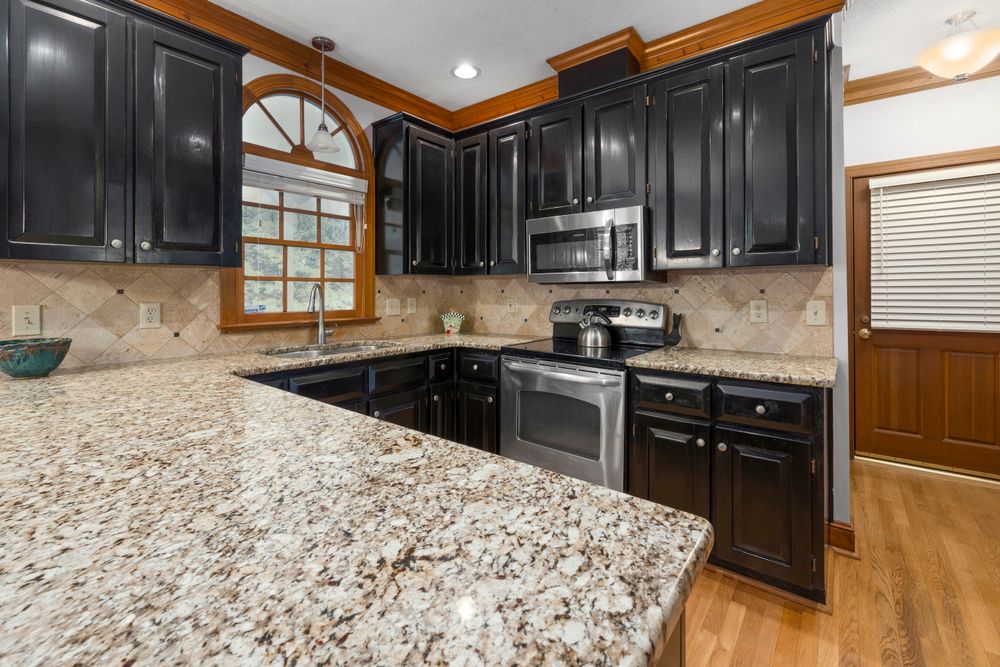
New knobs and pulls are the cheapest visual upgrade in the project. Two guides put them at $3–$15 each, and Family Interiors lists hinges at $6–$25. For our 28-piece example, one new knob or pull per piece adds $84–$420 by our arithmetic. Reusing existing hardware is free. One contractor blog lists hardware installation by a pro at $100–$1,000 or more.
DIY or hire a painter?
| Situation | Better choice |
|---|---|
| Flat or simple doors, 30 pieces or fewer, a spare room to lay doors flat | DIY, and most of the saving is real |
| Raised-panel doors, heavy oak grain, or a dark-to-light change | Hire, or expect harder prep |
| You want a smooth sprayed finish and cannot spray | Hire |
| Damaged boxes, peeling veneer or laminate that is lifting | Hire, or consider refacing or replacing |
| You can prep well but dislike painting | Split it: you prep, they paint |
Our honest take: the paint is cheap, and the real cost is your time, patience and space. If the job drags toward 45 hours, the saving works out nearer $35 an hour than $125. And a brushed finish will not look sprayed, however careful you are.
Common mistakes
- Skipping the degreaser or sanding. Contractors blame this most for early peeling.
- Rehanging too soon. Doors can stick to frames while the paint is dry but not hard.
- Using wall paint instead of cabinet enamel.
- Painting thick to save a coat, which risks drips and slow curing.
- Forgetting labels, so doors and hinges do not return to their original spots.
Ways to save
- Do the prep and reassembly yourself and hire only the painting. One guide estimates DIY prep saves $500–$1,000.
- Buy paint on sale. The same guide notes 20–40% discounts.
- Paint only what shows unless the insides are damaged.
- Get three written quotes that list the piece count, what is included (boxes, primer, topcoat, hardware) and the number of coats.
- Pair the paint with other cheap updates: peel-and-stick backsplash, countertop film or under-cabinet lighting.
Renting? Get permission first
Painting cabinets is an owner-level project. Many leases require written permission for alterations like this, so check yours, and expect a landlord to want unapproved paint undone at move-out. If you want it, ask in writing and ask whether they will pay for the paint. Our security deposit guide explains common deductions, and renter-friendly upgrades with prices lists changes that are easier to reverse.
Kitchen cabinet painting FAQ
Is painting cheaper than replacing cabinets?
Yes. One painting company says painting saves 60–80% compared with a full replacement priced at $15,000–$30,000 or more. That figure comes from a contractor, not a neutral study. Our refacing vs. repainting vs. replacing guide compares all three side by side.
Do I have to sand kitchen cabinets before painting?
Mostly yes. Benjamin Moore’s data sheet asks for roughening cabinetry with 220-grit or coarser before priming, and Family Handyman suggests a 120-grit scuff on previously painted doors. Degrease first, since grease clogs sandpaper.
How long do painted kitchen cabinets last?
Contractor estimates run from 8–10 years (Kitchensearch) to 8–15 years (Ranger) for professional work, and 3–7 years for DIY. These are company claims rather than tested figures, and wear depends on how hard the kitchen is used.
Can I paint laminate or thermofoil cabinets?
Sometimes. Benjamin Moore’s data sheet lists specific primers for laminate, MDF and thermofoil, so match the primer to the surface. Vinyl veneer is a harder case: the same sheet says to sand it away first.
Sources
Figures were compiled from these pages, checked in September 2026. Prices vary by region, and several are contractor blogs, so treat them as planning ranges, not quotes.
- Kitchensearch: cost to repaint kitchen cabinets (2026): per-door, per-drawer, per-linear-foot and size-based ranges.
- All Bright Painting: cost per door (Jan 2026): per-door price and sprayer rental.
- Ranger Painting: cost to paint kitchen cabinets (Aug 2026): size table, sprayed per-foot price, replacement comparison.
- Family Interiors: kitchen cabinet painting cost (Jul 2026): size table, materials and hardware prices.
- RealCostIQ: cabinet painting cost (Sept 2026): per-unit prices and condition multipliers.
- Minimal and Modern: cabinet painting budget guide (Jan 2026): DIY budget and saving tips.
- Brackens Painting: cost to paint kitchen cabinets (2025): itemized DIY costs, add-ons, durability claims.
- Southray: average cost to paint kitchen cabinets (Apr 2026): prep and durability claims.
- FIAXLO: cost to paint kitchen cabinets 2026: low-end per-door outlier.
- Bob Vila: cost to paint kitchen cabinets (2023): older price data and hours estimate.
- Homewyse: cost to paint kitchen cabinets (May 2026): per-square-foot range.
- Sherwin-Williams: how to paint kitchen cabinets: steps and drying times.
- Benjamin Moore Advance Semi-Gloss 793 data sheet: coverage, recoat, cure, sanding and primers.
- Rock’s Painting: recoat times by brand (May 2026): recoat and cure table.
- Hemlock Painting: how long cabinet paint takes to cure (Mar 2026): handling and curing advice.
- Family Handyman: 24 tips for painting kitchen cabinets: prep, primer and sheen advice.
- Family Handyman: how to spray paint kitchen cabinets: time, cost and sprayer notes.
- Family Handyman: best paint for kitchen cabinets: paint types.
- Shoreline Painting: spraying vs. brushing cabinets: pros and cons of each method.
- EPA: lead-safe renovations for DIYers: lead paint guidance and rental rule.